

California could plausibly support a regulated online gambling market worth roughly $12 billion a year. That would bring in more than $1 billion in tax revenue for the state every year. But California doesn’t have a regulated online gambling market. Neither does Texas, at an estimated $9.5 billion. Between them, two of the country's largest states are not participating in a regulated market that would rank among the biggest in America, and both have repeatedly declined to build one.
For this analysis, Bodog took actual 2025 revenue from states with mature regulated gambling markets, adjusted for population, and applied that rate to states missing the same products.
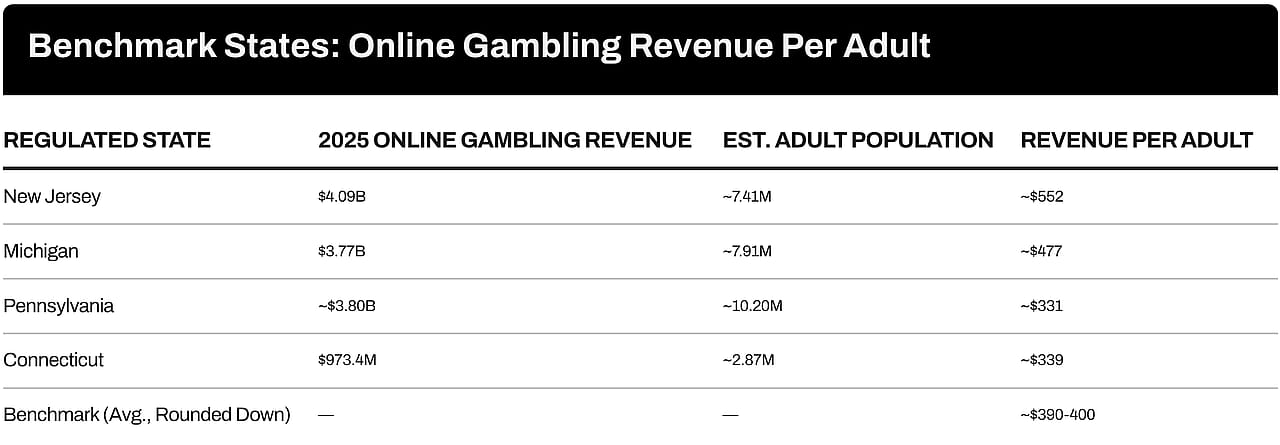
Four states anchor the model: New Jersey, Pennsylvania, Michigan, and Connecticut, all of which report full-year online casino and online sports betting revenue. In 2025, New Jersey generated $2.91 billion in iGaming revenue and $1.18 billion in sports betting revenue, a combined $4.09 billion. Pennsylvania posted roughly $2.93 billion in iGaming revenue and $867.8 million in sports betting, per the Pennsylvania Gaming Control Board. Michigan cleared $3.77 billion combined, and Connecticut posted $973.4 million.
Divide each figure by the state's estimated adult population, using 78% of total population as a standard adult-share estimate drawn from the U.S. Census Bureau QuickFacts, and a pattern emerges. New Jersey generates about $552 per adult, Michigan $477, Pennsylvania $331, and Connecticut $339.
The four-state average comes to roughly $435 per adult. To avoid overstating potential demand in states without established online markets, the analysis discounts that figure by about 10%, using a conservative benchmark of $390 per adult.
Multiply a state’s adult population by the benchmark, and you get a rough estimate of what a regulated market there could support. States missing both online casino and online sports betting get the full combined rate. Florida is the exception: It already has legal mobile sports betting through the Seminole Tribe's compact, so it only gets the lower, casino-only rate.
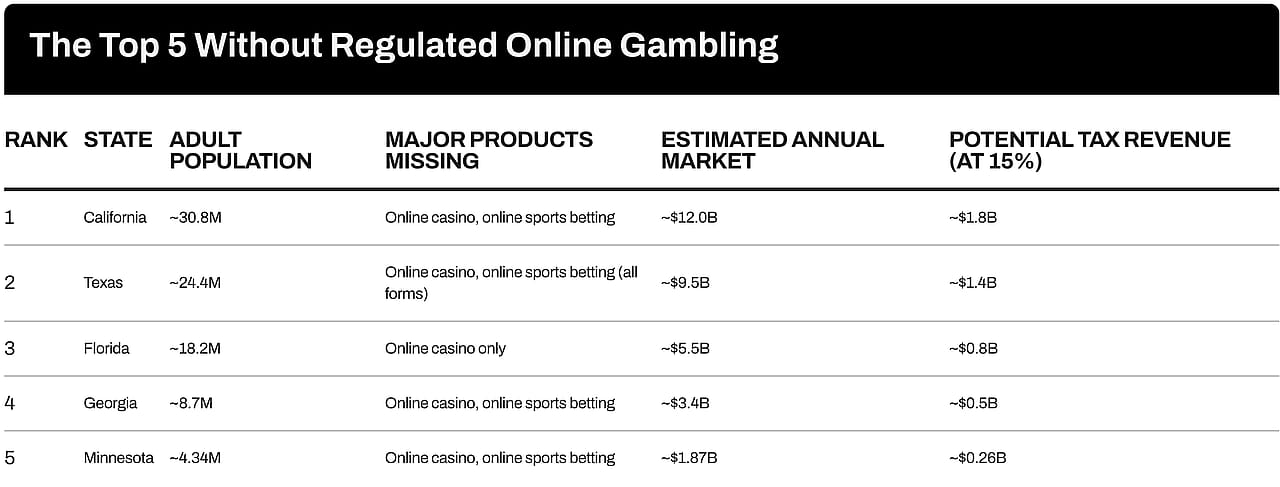
Florida's position says as much about the model as it does about Florida. Georgia and Minnesota have zero regulated online sports betting or online casino products at all, and yet Florida, despite already running legal mobile sports betting, still lands ahead of both simply because its population includes roughly 18 million adults.
Georgia's House rejected a sports betting constitutional amendment in March, with just 63 lawmakers voting for it, far short of the 120 votes required.
Texas hasn't passed anything either; its legislature adjourned in June 2025 without advancing a single gambling bill, and the next real shot isn't until 2027.
Minnesota (at roughly $1.8 billion) narrowly grabs the final spot. Despite a population approaching six million, the state still has no regulated online sportsbook or casino market. Minnesota has gone further than many holdouts, targeting offshore gambling and sweepstakes operators while also passing a law aimed at prediction markets. Under this population-based model, that leaves roughly $1.8 billion in potential annual regulated online gambling revenue on the table.
South Carolina (roughly $1.7 billion), Alabama (roughly $1.6 billion) and Utah (roughly $1.1 billion) sit just outside the top five. In Utah, the state constitution bans gambling outright. Hawaii, the other state with zero legal gambling, lands at around $440 million, showing how the model scales down as population shrinks.
None of this money simply disappears. The American Gaming Association's own research puts illegal and unregulated gaming revenue at $53.9 billion nationally, costing states more than $15 billion in lost tax revenue every year. Offshore and bookie-run sports betting alone accounts for an estimated $84 billion in handle, or amount wagered, and roughly $5 billion in revenue, according to the same AGA analysis.
Sweepstakes casinos, which operate in a dual-currency model that sidesteps most state gambling statutes, remain available in Texas, Florida and Georgia even though none of those states regulates real-money online gambling. California is the outlier there, too, having banned sweepstakes-style platforms outright starting January 1, 2026.
Federally regulated prediction markets add a genuinely new wrinkle. Kalshi and Polymarket self-certify under Commodity Futures Trading Commission oversight rather than state gambling law, which means residents of Texas, California, Georgia, South Carolina, and Alabama can already trade contracts on the Super Bowl, the World Series, or a presidential race without their state ever legalizing a single sportsbook.
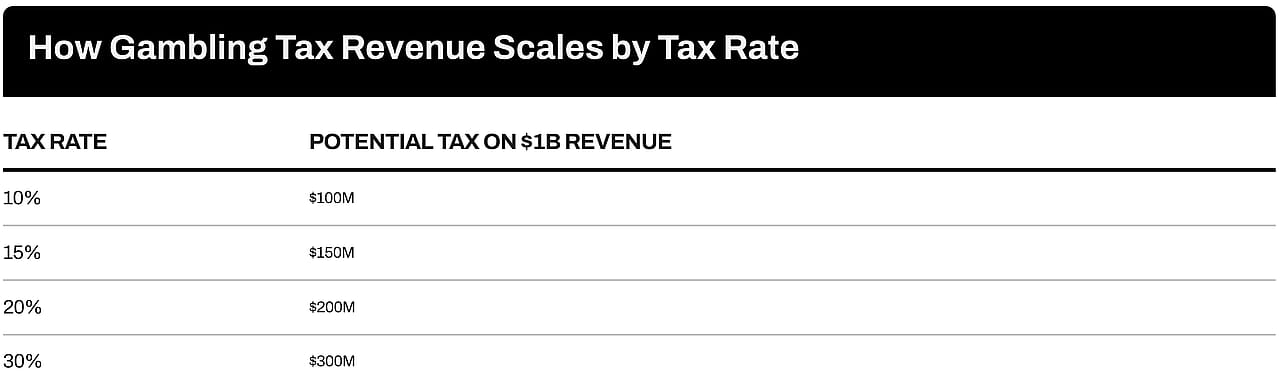
Revenue and tax revenue aren't the same thing. At a conservative 10% tax rate, California's estimated $12 billion market would generate roughly $1.2 billion a year in state tax revenue; at 20%, that climbs to $2.4 billion. Georgia's proposed lottery-run model and South Carolina's stalled bill haven't settled on final tax rates, so scenario ranges are more appropriate than a single number here.
This estimate is simple, while the states in question are anything but. So many factors are at play when a state considers legalizing betting, including licensing fees, number of available licenses, land-based tethers, tax models, and more. Plus, demand for gambling is uneven.
Tourism-heavy states, existing tribal casinos, neighboring-state access, and market maturity all push real numbers up or down from a flat per-adult rate. Nevada's proximity effect alone probably suppresses Utah's true demand below what a population-only model would suggest, and Florida's tribal gaming footprint complicates its own online casino math in ways a simple benchmark can't capture.
A state can decline to regulate online casinos or sportsbooks, and several of the country's largest states have done exactly that, repeatedly, for years. None of them can guarantee that residents will stop gambling, considering offshore books, sweepstakes platforms, and now federally regulated prediction markets.
These figures apply the roughly $390 combined per-adult benchmark (or the roughly $300 casino-only rate for Florida) to each state's estimated adult population, derived from 2024 Census population estimates at a uniform 78% adult share. This article reflects gambling revenue reported by the American Gaming Association for 2025. Bodog took the numbers provided by the AGA for states with mature gambling markets, adjusted for population, and extrapolated that rate to the biggest states with no legal gambling.
These are estimates based on a simple model and should not be taken as forecasts.
This story was produced by Bodog and reviewed and distributed by Stacker.


