BOCC Votes Against Latest East of FDAB Development
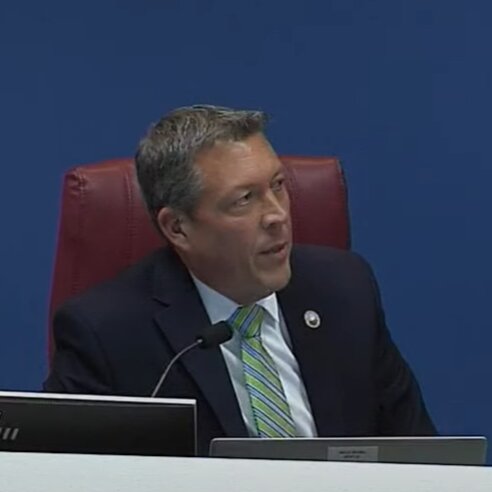
Commissioner George Kruse makes the case for the board to repeal the county's Comprehensive Plan Policy 2.1.2.8.
Posted
Dawn Kitterman
BRADENTON — At a land use meeting Thursday, the Manatee County Commission voted against the transmittal of a large-scale comprehensive plan text amendment and rezone for Pulte Homes' proposed Lazy C Ranch. An approval would have paved the way for at least another 1,100 homes east of the county's Future Development Area Boundary.
The application was put on the fast track after being recommended for approval by the planning commission last week.
The project would have covered 495 acres off of Rye Road and was to be located between three other planned developments: The Aviary to the west, Foxbrook to the east, and Rye Ranch to the south. While much of the project’s acreage lay east of the FDAB and is currently zoned as agricultural use (allowing for one house per five acres), about 20 percent exists on the west side of the Future Development Boundary and is zoned UF-3 which allows for 3 units per acre. The developer was seeking a max density of 2.2 units per acre and a rezone to the acreage that lies east of the FDAB to UF-3.
In recent months, the board has seen such requests from developers on multiple occasions, proposing master developments east of the county’s FDAB citing comprehensive plan compliance based on Policy 2.1.2.8. The somewhat new policy allows for rezoning and development east of the FDAB in situations where the applicant can show the proposed development is "contiguous and coterminous" to an existing master development. However, the board has struggled to clearly understand what Policy 2.1.2.8 permits and the specific definition of "existing master development."
Most recently, the board’s approval of Carlos Beruff’s proposed East River Ranch development—which is slated to bring 5,300 homes and more than a million square feet of commercial space east of the FDAB—relied upon Policy 2.1.2.8. In that instance, the "contiguous and coterminous" qualifier seemed largely based on previously approved SMR Taylor Ranch. However, Taylor Ranch is only just beyond its greenlight and hardly a physically "existing master development." The mere approval as to its future development appeared to be the foundational qualifier as an adjacent "contiguous and coterminous" development.
Pulte Homes’ Lazy C Ranch relied upon Policy 2.1.2.8 as well, arguing that the future development of this site was subject to 2.1.2.8, because of other approved prior master developments to the north, east, and south, but also because a lesser portion of the development would be west of the FDAB and when developed first would provide the "contiguous and coterminous" qualifier as required in 2.1.2.8.
"This portion of the site can only be developed once the 90.57± acre portion of the project west of the FDAB is built to the point where all public infrastructure is available from the west to service this site," the staff report as attached to the meeting’s agenda item detailed.
A requirement for the developer to first build out the western portion of the project appeared inconsistent with the approval of East River Ranch under Policy 2.1.2.8 given that East River Ranch was able to meet the requirements based on prior approval and not a guarantee that Taylor Ranch would be completed before East River Ranch could begin. The inconsistency in the application of Policy 2.1.2.8 did not go unnoticed by some commissioners.
Commissioner George Kruse raised several concerns over the requested approval to transmit the Lazy C Ranch rezone and text amendment. Kruse questioned whether there was any analysis completed by staff to assess traffic, utility, and water use impacts of Lazy C Ranch if approved. He also raised concerns about Policy 2.1.2.8 and whether the policy itself was a "good policy."
"I’m looking at the implementation mechanisms for 2.1.2.8 and it specifically says that we have the right to limit the number of units and square footage within the policy. But I don’t know if I need to limit it," Kruse stated, citing the lack of information on traffic and water use impacts.
"It also says that we have to review and approve an LDA (Land Development Agreement) and that the LDA has to address construction and timing of roadway and utilities infrastructure as an implementation of Policy 2.1.2.8," Kruse continued. "But we don’t have any of that information…I feel like I am being asked to approve something without enough information to approve it."
Kruse went on to express his opinion that the policy being used to approve developments beyond the FDAB appeared, in his assessment, to be used inconsistently or vaguely, causing the board to make approvals that they could not entirely understand the potential future implications of.
"I don’t like the process for it honestly, I can’t get comfortable with approving things under this policy without having enough information to know what I’m approving," Kruse said.
Kruse's expressed concerns gained some agreement among board members with Commissioner Kevin Van Ostenbridge stating that he too felt as though he was being "coaxed down the rabbit hole" without having enough information. Commissioner Mike Rahn also agreed with Kruse saying that he felt the policy needed "more teeth" and clarity.
During the discussion and deliberations for Lazy C Ranch, Kruse interjected that it was his intention to make a motion later in the meeting to request the board consider potentially "yanking" or suspending the policy altogether until "the board could better assess what had been put into the comp plan" with the addition of Policy 2.1.2.8.
"I think we need to reassess this policy in its entirety," Kruse suggested.
Kruse again received multiple comments in support from fellow board members. Commissioners Rahn, Satcher, Ballard, and Van Ostenbridge each vocalized a need to address the shortcomings of Policy 2.1.2.8, but Ballard and Rahn also stated that denial of the Lazy C Ranch request due to concerns with the existing policy would be unfair to the applicant.
"The applicant is doing exactly what is appropriate under our current policy," Ballard said.
Setting their discussion about policy aside, the board resumed its deliberations on the requested transmittal for Lazy C Ranch. Though Ballard and Rahn were firm in their positions that a denial for the transmittal to the state would be "penalizing" to the applicant if based on concerns about Policy 2.1.2.8, both reasserted their earlier support and agreement with Kruse’s comments about the policy.
Kruse, however, remained focused on the unknown impacts the development might have on traffic and water utilities. The vote to approve failed, 4-2, with only Rahn and Ballard voting to approve transmittal and Commissioner Vanessa Baugh absent. Despite Van Ostenbridge, Satcher, and Bearden joining Kruse in casting dissenting votes to approve the rezoning, no other commissioners elaborated as to the basis of their dissent.
Several hours later in the meeting, after three short recesses and the completion of the meeting’s agenda, Kruse followed through on his earlier stated intention and made a motion concerning Policy 2.1.2.8. Taking into account legal counsel’s advice that a comp plan policy could not simply be "suspended" but would require appropriate process, including transmittal to the state, it was determined the best course of action to meet Kruse’s goal would be for the board to repeal the policy, work to revise it, and then reinsert the improved version back into the comp plan.
County development staff offered that the timing of such an action would be suitable, noting that work toward the board’s goal of rewriting the county’s comprehensive plan was already underway. Repealing the policy now might allow for a more cohesive review and reinsertion in concert with the comp plan's overhaul.
By the time he made the motion to repeal 2.1.2.8, Kruses found he had lost the support his colleagues had offered earlier in the day. Despite continued agreement that the policy was problematic and in need of amendment, commissioners disagreed with repealing the policy first and instead said they only wanted to see revisions to the existing policy. Unwavered, Kruse attempted to appeal to the board the need for them to take swift action to stop additional development requests coming forward under Policy 2.1.2.8.
"I just don’t like repealing stuff. I mean, it’s not a bad policy, it’s just a policy that needed to be worked through more when it was put into place," Rahn said.
"If we leave this as is until we get around to having work sessions," Kruse stressed, responding to the shift in opinion of the board. "You know that’s going to take a long time and you know the pressure is going to be on dragging your feet and making it take a long time because there are people who want this policy as it stands today in our comp plan for as long as possible."
Kruse summarized his arguments for repealing the policy by suggesting revisions to 2.1.2.8 would move more quickly if the policy was first repealed.
Kruse’s motion to repeal the policy failed for lack of a second.
To replay the portion of Thursday’s land use meeting relating to concerns about Policy 2.1.2.8, click the video below.
To replay the board’s discussion at the conclusion of the meeting concerning a motion to repeal 2.1.2.8, click the following video.
To rewatch the full presentation, discussion, public comments, and vote on agenda item 16, Lazy C Ranch Large-Scale Comprehensive Plan Map Amendment, click the video below.



Comments
No comments on this item
Only paid subscribers can comment
Please log in to comment by clicking here.