
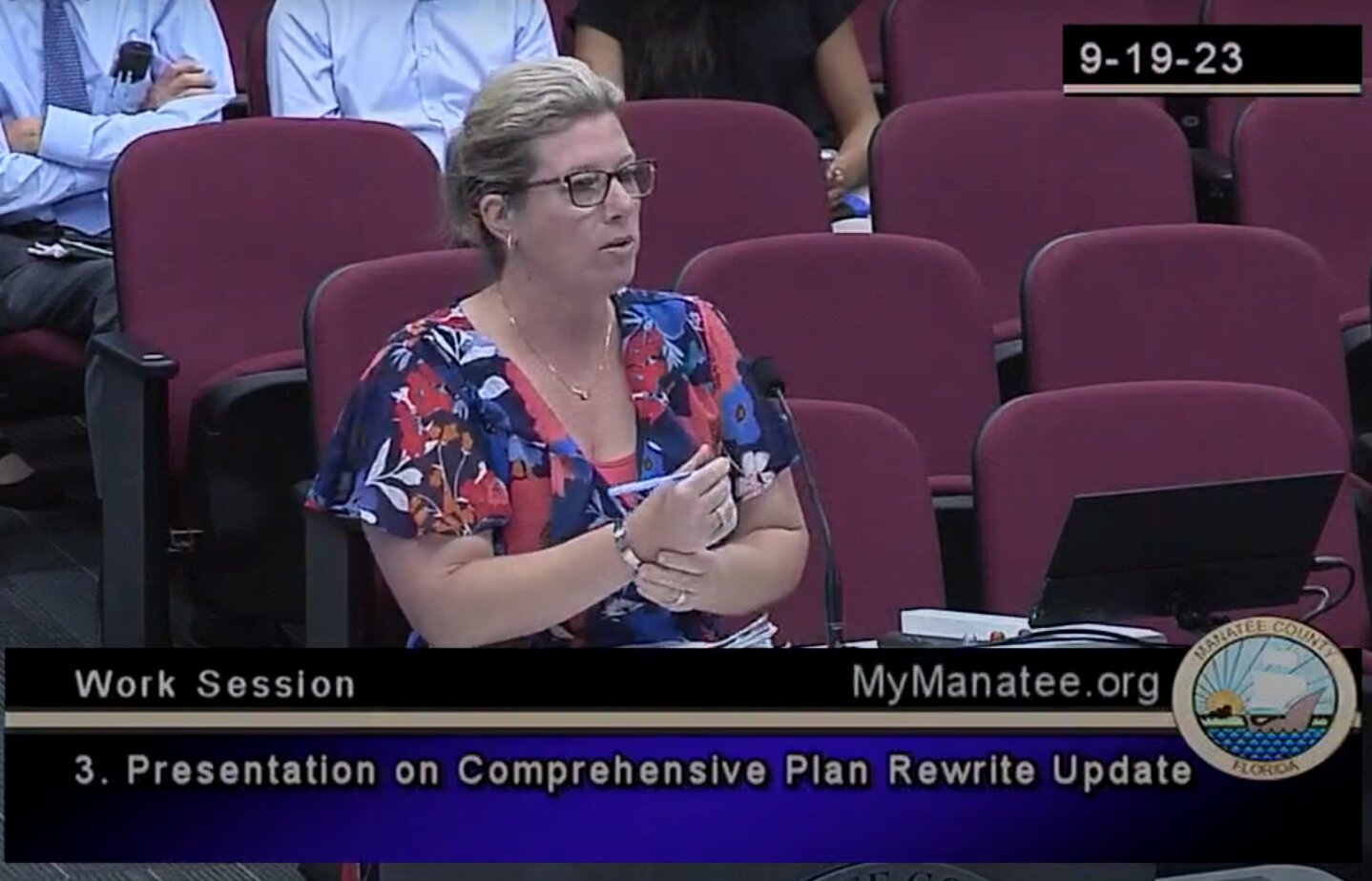
BRADENTON — On Tuesday, the Manatee County Commission held a work session meeting which included discussions on two matters related to rapid growth and development in Manatee County.
Commissioners received a presentation from county staff of the Departments of Utilities and Development Services on Comprehensive Plan Policy 2.1.2.8. The board also heard an update from engineering consultant firm Kimley-Horn on the progress of the county’s effort to update the Comprehensive Plan.
Comp Plan Policy 2.1.2.8, which relates to development east of the Future Development Area Boundary (FDAB), was an item the board had previously requested be discussed and reviewed for potential revisions.
Policy 2.1.2.8. allows for rezoning and development east of the FDAB in situations where the applicant can show the proposed development is "contiguous and coterminous" to an existing master development. However, county staff and commissioners have at times struggled to clearly understand what the policy permits and the specific definition of "existing master development."
The policy was first adopted in November 2021, but in June of this year Commissioner George Kruse raised concern with the policy, initially going so far as to suggest the board should consider “repealing” it.
Initially, it seemed as though the majority of commissioners agreed with Kruse’s concerns about the clarity of the policy, but upon returning from meeting recess, it appeared much of that support had waned. Ultimately, the board agreed to take up a work session discussion on the policy in an attempt to determine ways the policy might be improved or revised.
The discussion that was held on Tuesday—and the associated staff presentation—was not quite the same discussion as the board requested back in June, however. Instead, the staff presentation focused on the board’s future approval for county staff to hire a consultant to conduct a Facility Investment Fees (FIF) study. Specifically, a FIF study solely focused on the area east of the FDAB line.
“I was under the impression that this was going to be a more substantial discussion on that policy,” Kruse said following the presentation.
Kruse acknowledged that he felt a FIF study was an important part of considerations concerning Policy 2.1.2.8., but suggested there were other important aspects of the policy the board should also discuss. The commissioner highlighted the item’s title as it appeared on Tuesday’s meeting agenda and questioned whether the presentation the board received matched the intent of the work session item.
“So, that’s it? We’re all now happy with 2.1.2.8. based upon a nodding of the heads to maybe bring back having a study on one component of it?” Kruse questioned.
Commissioner Mike Rahn expressed that he too expected more information, discussion and clarity on the policy during the work session. Rahn reaffirmed comments he provided in June that he did not support the removal of 2.1.2.8, but did see the need for the policy to have “more teeth.” Rahn added that he also did not agree with the policy’s inclusion as a comp plan policy and stated “it should be in the land development code.”
Given that Tuesday’s meeting was a work session and not a special or regular meeting, the board was unable to vote for any approvals or actions. The board did, however, seem to agree with the staff’s recommendation that the county should seek a FIF study, but the item would need to be returned to the board in a future meeting for official approval.
A FIF fee is a development fee for new water/sewer customers. In partnership with developers, the county typically shares the expense of building long-term infrastructure, including pipe extensions, water plant upgrades or expansions, or new plant construction. With the increasing rate of large development approvals east of the FDAB, the county’s existing utility infrastructure will be unable in its current construction to keep up with growth.
The FDAB line runs north-south and lies west of the more rural, agricultural eastern edge of the county. The boundary was established in 1989 to keep most development west of the line and prevent urban sprawl into areas that lack infrastructure services such as water and sewer.
The county’s most recent FIF study was conducted in 2019 and carries a 5-year applicability. However, the 2019 study did not consider the area east of the FDAB when calculating future utility infrastructure demands and needs since that area of the county had not been previously anticipated for future development.
On Tuesday, Kruse questioned whether it would make more financial sense to hire a consultant to conduct an all-inclusive FIF study, rather than one that only focused on areas beyond the FDAB. He suggested that the 2019 study would be aging out soon and any new FIF study would be more complete and perhaps a better investment if focused countywide.
The request for the board to approve an FIF study should appear on a future BOCC actionable meeting agenda, though the anticipated future date for its approval was not announced Tuesday.
In another development-related item on Tuesday’s work session agenda, Kelley Klepper of Kimley-Horn provided commissioners with an update on the progression of the county’s effort to review and update its comprehensive plan.
Klepper shared with commissioners that he is an 18-year resident of Manatee County and shares a vested interest in how the community develops and grows.
The county’s effort to rewrite its comprehensive plan was kicked off on May 1. To date, associates of Kimley-Horn have attended meetings with county department heads and other county staff, as well as hosted several community workshops with members of the public.
Holding up a sizable stack of papers, Klepper told commissioners, “This is your current comprehensive plan…you have way too much in this plan.”
Klepper, who said he has read every page of the county’s comp plan—which was written in 1989—explained that the update process includes the analysis of the plan against current and updated statutes, as well as reviewing and updating its goals, objectives, and policies which provide the future vision of the community over a 10-20 year period. The analysis is done across many service areas and/or needs of the community, including traffic and transportation, potable water, sewer, stormwater, parks, population and land use.
As part of the review and data collection, a series of community workshops collected input from more than 150 members of the public. Comments collected from the public included shared concerns and citizens’ own future vision for the county’s growth and development.
Klepper shared a “word cloud” which displayed a collection of words shared by the public that best described their desired future vision of Manatee County. Some of the words that appeared most pronounced—suggesting the number of times the word was used by multiple members of the public—were "conservation,” “affordable,” “integrity,” and “Ag.”

Klepper shared that the key takeaways from the feedback collected showed that the public’s priority-ranked concerns included water quality and protecting water resources, land conservation, housing and affordability, traffic congestion, retaining and expanding county parks and open space, and development and growth.
Next, said Klepper, a 3-week online survey will be launched to seek more input from the public. Once launched, a link will be provided through the county’s website. The goal of the online survey is for broader response and input collection, as well as to provide an opportunity for those who attended the previously held public work sessions to expand on the thoughts they may have already shared.
Yesterday was the first update presented to commissioners as the process moves forward. Additional updates will be provided throughout the process during future BOCC meetings.
To view the slideshow presented on the comp plan update, click here.
To rewatch both item presentations and discussions from Tuesday’s BOCC work session, click the video below. The entire work session, which ran about one hour and 30 minutes, can also be viewed by clicking the link below.


1 comment on this item
Only paid subscribers can comment
Please log in to comment by clicking here.
ruthlawler
I also attended a Kimley-Horn public input session, which was well conducted. Our group voiced and documented many of the same concerns: land conservation, housing affordability, water quality, traffic issues, and leadership accountability and integrity. The irony is that what the public voices as important often seems in direct opposition to this BOCC actions and focus. Most on our BOCC ignore and don't respond to citizens concerns or comments. A perfect example of actions contrary to public input, which includes highly qualified scientists and life long conservationists, is the proposed rollback of our wetlands buffers. Many of us have written to and spoken in public addressing our Commissioners, only to be ignored and at times smirked at and berated. How immature and unprofessional! To say we need new leadership is an understatement! I have lived in Manatee County 60 years and have NEVER seen anything like this. Ruth Lawler
Wednesday, September 20, 2023 Report this